
Why Does Qatar Reject Visa Applications?
Getting a Qatar visa rejection can be frustrating, especially when you have already booked flights or made travel plans. The good news is that most rejections happen for preventable reasons, and understanding those reasons gives you a much better chance of approval on your next attempt.
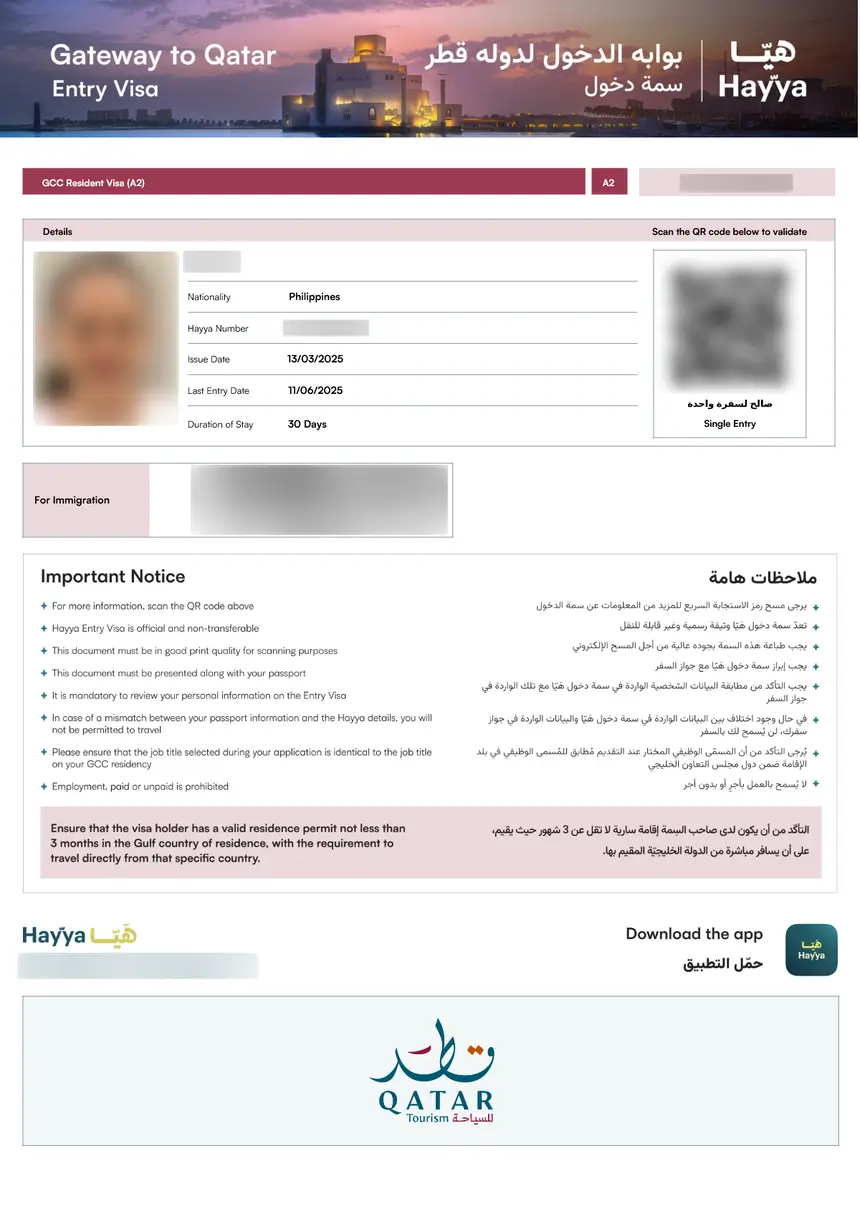
Qatar’s immigration authorities evaluate each application against a set of criteria covering your documents, personal history, financial standing, and the purpose of your visit. If any of these areas raise concerns, the application may be denied. In some cases, the rejection is linked not to the applicant but to the sponsoring employer or agency.
This guide explains every common reason for Qatar visa rejection, how to check your application status, what to do after a denial, and how to avoid problems in the future.
Common Qatar Visa Rejection Reasons
Incomplete or Incorrect Application
One of the most frequent reasons for Qatar visa rejection is simply an incomplete application. This includes:
- Leaving mandatory fields blank
- Providing inconsistent details (different name spellings, wrong dates)
- Submitting outdated or incorrect application forms
- Uploading documents in the wrong format or resolution
The Hayya platform processes thousands of applications daily. Even small errors can trigger an automatic rejection. Double-check every field before submitting.
Expired or Invalid Passport
Qatar requires your passport to be valid for at least six months beyond your intended date of entry. This is a strict rule with no exceptions. If your passport expires within six months of your planned arrival, your application will be rejected automatically.
Other passport-related issues include:
- Damaged passports (water damage, torn pages, illegible text)
- Passport photo page not clearly scanned or uploaded
- Using a passport that does not match the nationality declared in the application
Insufficient Financial Proof
Qatar wants to ensure that visitors can support themselves during their stay. If you cannot demonstrate sufficient funds, your visa may be denied. This is especially relevant for:
- Tourist visa applicants who cannot show bank statements
- Business visa applicants without a letter of financial guarantee
- Family visit visa applicants where the sponsor’s salary is below the threshold
For work visas, the employer’s financial standing may also be reviewed.
Criminal Record or Security Concerns
Qatar conducts background checks on all visa applicants. If you have a criminal record, pending legal cases, or appear on security databases, your application is likely to be denied. This applies to:
- Criminal convictions in any country
- Outstanding arrest warrants
- Previous deportation or removal orders from Qatar or GCC countries
- Suspicion of involvement in illegal activities
Previous Visa Overstays or Violations
If you have previously overstayed a visa in Qatar or any other GCC country (Bahrain, Kuwait, Oman, Saudi Arabia, UAE), your new application may be rejected. Qatar shares immigration data with other GCC states, so violations in one country can affect your ability to enter others.
Common violations include:
- Overstaying the allowed period on a previous visit
- Working on a tourist or visit visa
- Failing to exit the country before visa expiry
- Violating the terms of a previous visa
Missing or Unacceptable Documents
Different visa types require different supporting documents. Missing or improperly prepared documents are a leading cause of rejection. Common issues include:
- No hotel booking confirmation (required for some visa types)
- Missing invitation letter for family or business visas
- Employment documents not attested or not translated into Arabic
- Educational certificates not verified by the relevant authorities
- No return flight booking for tourist visas
For work visas, the employer must provide a valid employment contract, and certain nationalities must complete procedures at a Qatar Visa Centre in their home country.
Health-Related Rejections
Certain visa types, particularly work visas, require a medical examination. The following health conditions can lead to visa denial:
- Active tuberculosis (TB)
- HIV-positive status
- Leprosy
- Other communicable diseases deemed a public health risk
The medical exam must be completed at an approved facility. Results from unapproved clinics will not be accepted.
Sponsor or Employer Issues (Work Visas)
For work visa applications, the rejection may have nothing to do with the applicant. The sponsoring employer may be the problem. Common employer-side issues include:
- No valid labour recruitment approval – The employer must have an approved quota covering the worker’s profile (profession, nationality, gender)
- Expired commercial registration – The company’s establishment records must be active
- Ministry of Labour restrictions – Unresolved compliance issues can block new applications
- Profession mismatch – The job title may not align with the employer’s registered business activities
- Incorrect quota details – The application must match the employer’s available approval exactly
If your work visa is rejected, ask your employer to check their government portal for specific rejection details.
Mismatched Information
Any discrepancy between your application and supporting documents can trigger a rejection. Common mismatches include:
- Name spelling differences between passport and application
- Wrong passport number
- Date of birth does not match
- Nationality or gender listed incorrectly
Even a small difference – such as a missing middle name or a transliteration variation – can cause problems. Make sure every detail matches your passport exactly.
Age or Gender Restrictions
Some visa categories have age or gender limitations. For example:
- Certain labour visas may have minimum or maximum age requirements
- Some work visa quotas are restricted by gender for specific professions
These restrictions are set by the Ministry of Labour and can change without notice.
How to Check Your Qatar Visa Rejection Status
If your application has been rejected, you can check the status and, in some cases, the reason through several channels:
Hayya Platform Dashboard
Log into your account at hayya.qa. The dashboard will show your application status. If rejected, the reason may be displayed under your application details. However, in certain cases, the specific reason may not be provided.
MOI Visa Services Portal
The Ministry of Interior’s Visa Services portal allows you to:
- Track an application using the application number
- Check an issued visa using the visa number
- Print or reprint visa details
Ask your sponsor or employer for the correct application number if you do not have it.
Metrash App
The Metrash mobile application (by the Ministry of Interior) provides visa status tracking. Employers and authorised representatives can use it to monitor applications. Note that overseas applicants without a Qatar ID may not have access to all functions.
Qatar Visa Centre Tracking
If your application involves a Qatar Visa Centre (for nationalities from Bangladesh, India, Nepal, Pakistan, the Philippines, and Sri Lanka), you can track medical, biometric, and appointment progress through the official QVC platform.
What to Do After Your Qatar Visa Is Rejected
A rejection is not the end of the road. Here are the steps to take:
1. Identify the exact reason
Check your Hayya dashboard, rejection email, or MOI portal for the stated reason. If the reason is not clear, contact the Hayya support team:
- Email: [email protected]
- Phone: +974 4441 2022 (available 24/7 in Arabic, English, Hindi, Urdu, and Tagalog)
2. Fix the problem
Once you know the reason, take corrective action:
- If documents were missing, gather and upload them
- If your passport was expired or damaged, renew it
- If information was incorrect, prepare a corrected application
- If the issue was employer-related, ask your sponsor to resolve it on their end
3. Remove the rejected application
Before reapplying through the Hayya platform, make sure the rejected application has been removed from your dashboard. Some users report that leaving a rejected application in the system can interfere with new submissions. If you cannot remove it yourself, contact Hayya support.
4. Reapply with corrections
Submit a new application with all corrections made. Per the Hayya Terms of Use, you are allowed to make two further attempts after an initial rejection, provided you supply the corrected application data and any additional information requested.
5. Seek professional help for complex cases
If your application has been rejected multiple times or the reason involves security clearance, immigration history, or employer-side issues, consider consulting:
- A licensed immigration lawyer in Qatar
- A registered visa processing agency
- Your country’s embassy or consulate in Doha
Can You Reapply After a Qatar Visa Rejection?
Yes, you can reapply after a Qatar visa rejection. There is no mandatory waiting period for most visa categories, but the rules depend on the type of visa and the reason for rejection.
| Situation | Can You Reapply? | Waiting Period |
|---|---|---|
| Missing or incorrect documents | Yes | No waiting period – fix and resubmit |
| Expired passport | Yes | Renew passport first, then reapply |
| Hayya A1 tourist rejection | Yes (up to 2 more attempts) | Per Hayya Terms of Use |
| Work visa rejection (employer issue) | Yes, once employer fixes the issue | Depends on employer resolution |
| Security or immigration ban | Consult an immigration lawyer | May require formal appeal |
| Blacklisted or deported | Not without legal clearance | Case-by-case basis |
Important: If you were told to wait 30 days before reapplying (common for Hayya platform rejections), follow that instruction. Submitting multiple applications too quickly can flag your account.
How to Avoid Qatar Visa Rejection
Follow these best practices to maximise your chances of approval:
- Check passport validity – Ensure at least six months remaining before expiry
- Match all details exactly – Name, date of birth, passport number must be identical across all documents
- Provide complete documents – Submit everything required for your specific visa type
- Use clear, high-quality scans – Blurry or cropped passport scans are a common rejection trigger
- Show sufficient funds – Prepare recent bank statements if financial proof is required
- Be honest about your history – Concealing previous violations or criminal records will likely be discovered
- Verify your sponsor – For work visas, confirm your employer has valid recruitment approval
- Complete medical exams at approved facilities – Only results from designated clinics are accepted
- Get documents attested – Educational certificates, police clearances, and employment contracts may need official attestation
- Apply through official channels – Use the Hayya platform directly or a licensed agency
FAQ
Why is my Qatar visa getting rejected?
The most common reasons include incomplete or incorrect applications, expired passports (less than six months validity), insufficient financial proof, missing documents, previous visa violations, or a criminal record. For work visas, the employer’s recruitment approval or company registration may also be the cause.
Is a Qatar visa difficult to get?
Qatar’s visa process is straightforward for most nationalities. Many countries enjoy visa-free entry, and the Hayya e-visa system has simplified applications for others. Rejections typically happen due to avoidable mistakes rather than strict policies.
How do I check my Qatar visa rejection reason?
Log into your Hayya account at hayya.qa and check your dashboard. The rejection reason may be shown under your application. You can also use the MOI Visa Services portal or contact Hayya support at [email protected] or +974 4441 2022.
Can I reapply for a Qatar visa immediately after rejection?
In most cases, yes. There is no mandatory waiting period for tourist and visit visas. However, the Hayya platform allows only two additional attempts after an initial rejection. For work visas, you may need to wait until the employer resolves the underlying issue.
What should I do if my Hayya visa is rejected?
Check the rejection reason on your Hayya dashboard, correct the issue (missing documents, incorrect details, etc.), remove the rejected application from the system, and submit a new application. Contact Hayya support if the reason is unclear or if you cannot remove the old application.
Can a previous overstay in Qatar affect my new visa application?
Yes. Overstaying a previous visa in Qatar or any GCC country can lead to automatic rejection of future applications. Qatar shares immigration data with other GCC nations. You may need to pay any outstanding fines and obtain legal clearance before reapplying.
Does having a criminal record disqualify me from getting a Qatar visa?
A criminal record does not automatically disqualify you, but it significantly reduces your chances. Qatar conducts thorough background checks. The outcome depends on the nature of the offence, when it occurred, and whether it is considered a security concern by Qatari authorities.
What medical conditions can lead to Qatar visa rejection?
Active tuberculosis (TB), HIV-positive status, leprosy, and other communicable diseases can result in visa denial. Medical examinations must be completed at approved facilities. This requirement applies primarily to work visa applicants.
Can my employer cause my Qatar visa to be rejected?
Yes. For work visas, the employer must have valid labour recruitment approval (quota), active commercial registration, and no Ministry of Labour restrictions. If any of these are missing or expired, the visa application will be denied regardless of the applicant’s qualifications.
How long should I wait before reapplying after a Qatar visa rejection?
For tourist and visit visas, you can usually reapply immediately after fixing the issue. Some Hayya rejections require a 30-day wait. For work visas, the waiting period depends on the nature of the rejection and how quickly the employer can resolve their side of the issue.